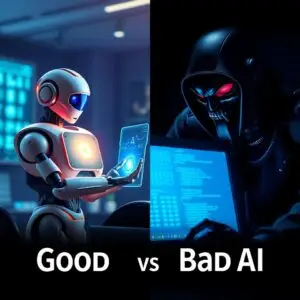
, but also terrible things. This para
Artificial intelligence is simultaneously the most hopeful and most terrifying technology humans have ever unleashed on themselves. In one corner, AI just mapped over 200 million protein structures and is helping researchers develop drugs that could end diseases that have plagued humanity for centuries. In the other corner, a finance worker in Hong Kong wired $25 million to criminals because an AI-generated deepfake of his CFO told him to — on a live video call, surrounded by other AI-generated fake colleagues, all looking perfectly real (Channel News Asia, 2024).
So yes. We built a technology that can cure cancer and convincingly impersonate your boss to empty your bank account. Congratulations, humanity. We’ve done it again.
At Network Essentials, we’ve been helping Charlotte businesses navigate the real-world implications of technology since 2002. We’ve watched a lot of technological waves — some exhilarating, some catastrophic, most both. But AI? AI is something else entirely. It’s playing chess at a level no one saw coming, and unfortunately, some of the best players are criminals.
Here’s the full picture — the astonishing good, the genuinely terrifying bad, and what you, as a Charlotte business owner, need to do about it before someone does it to you.
The Good: AI Is Actually Doing Some Miraculous Things
Let’s start with the hope, because there is genuine, verifiable, Nobel-Prize-winning cause for optimism. AI isn’t just autocompleting your emails and recommending increasingly unhinged YouTube videos. It’s doing things that would have sounded like science fiction ten years ago.
It Cracked One of Biology’s Hardest Problems in a Weekend
For 50 years, one of science’s grand unsolved challenges was the “protein folding problem” — figuring out the 3D shape of proteins from their genetic sequence. This matters enormously because proteins do essentially everything in biology, and most drugs work by interacting with specific protein shapes. Figuring out one protein’s structure used to take researchers years.
Google DeepMind’s AlphaFold didn’t just solve it. It obliterated it. AlphaFold has now mapped the structures of over 200 million proteins — virtually every protein known to science — and made them freely available to researchers worldwide (AlphaFold Protein Structure Database, EMBL-EBI). The Nobel Committee awarded the 2024 Nobel Prize in Chemistry partly to the AlphaFold team. In five years, AlphaFold’s database has been used by more than 3 million researchers across 190 countries (Google DeepMind, 2026).
To put that in perspective: science just got a master key to the lock of biology. New cancer drugs, antibiotic resistance solutions, and treatments for diseases we’ve never been able to touch are now in active development because of this. That’s not hype. That’s the Nobel committee saying so out loud.
It’s Catching Cancer Before Your Doctor Can
AI-powered diagnostic tools are detecting cancers, diabetic retinopathy, cardiac abnormalities, and neurological conditions at accuracy rates that rival — and in some cases exceed — experienced specialists. AI triage tools are reducing breast cancer diagnosis wait times. AI models are analyzing CT scans and finding tumors human radiologists miss.
We’re not talking about robots replacing doctors. We’re talking about giving every overworked clinician a tireless, infinitely attentive second set of eyes that never has a bad day, never rushes through a scan because it’s 7 PM on a Friday, and never gets distracted.
It’s Helping the Planet Not Catch Fire (As Fast)
AI weather and fire prediction models are now providing wildfire risk assessments with local specificity that traditional models couldn’t achieve. The European Centre for Medium-Range Weather Forecasts’ AI models are providing more accurate fire danger predictions earlier than legacy systems — giving emergency services precious additional hours to position resources before a blaze spreads.
AI is also being applied to power grid optimization, reducing energy waste, and accelerating the development of next-generation battery technology for renewable energy storage. Not saving the planet single-handedly, but genuinely helping in ways that are measurable and real.
It’s Democratizing Expertise
A small healthcare practice in Charlotte’s University area now has access to AI-assisted diagnostic tools, documentation automation, and clinical decision support that would previously have been available only to major academic medical centers. A 10-person law firm can use AI to research case law with the depth a 200-attorney BigLaw firm would have needed a team of paralegals to match. A family-owned manufacturer in Concord can use AI for supply chain forecasting that was previously only accessible to Fortune 500 companies.
That democratization of intelligence — leveling the playing field for small businesses — is genuinely exciting. It’s also, naturally, exactly where the story turns.
The Bad: Same Technology, Different Users, Catastrophic Results
Here’s the thing about powerful tools: they don’t come with ideology. The same AI capabilities that help a radiologist catch a cancer also help a criminal craft an undetectable phishing email. The same voice synthesis that helps a person with ALS communicate also helps a scammer clone your CFO’s voice well enough to authorize a $25 million wire transfer.
The bad guys didn’t sleep through the AI revolution. They enrolled in it first.
They Built Their Own ChatGPT — Without the Rules
Meet WormGPT and FraudGPT. These aren’t science fiction. They are real, commercially available AI tools sold on dark web marketplaces — purpose-built versions of large language models with all ethical guardrails deliberately removed. No refusals. No safety filters. Ask it to write a perfect phishing email impersonating your bank, your CEO, or the IRS? Done in seconds. Ask it to generate malware code? No problem. Ask it to craft a business email compromise attack targeting a specific company’s accounting team? Here are five variations, personalized, in the tone and writing style of the executive you’re impersonating.
FraudGPT was reportedly available for subscription fees as low as $200/month on Telegram and dark web forums — meaning sophisticated, AI-assisted cyberattacks are now accessible to anyone with a credit card and malicious intent (Daily Security Review, 2025). The technical barrier to conducting a professional-grade cyberattack has effectively been eliminated.
The result? Phishing attacks surged 1,265% between 2022 and 2024, with the explosion attributed directly to generative AI tools (Brightside AI, 2025). Not 12%. Not 126%. Twelve hundred and sixty-five percent. That’s not a trend line. That’s a cliff.
Your Boss Isn’t on That Video Call
Let’s revisit that Hong Kong story, because it deserves more than a passing mention. In early 2024, a finance employee at a multinational company received a message asking them to participate in a video call with the company’s CFO and several other executives to discuss a confidential transaction. The call happened. The CFO was there. The colleagues were there. The conversation was normal. Completely convincing.
Every single person on that call — except the employee — was an AI-generated deepfake. The employee transferred $25 million before anyone realized what had happened.
This wasn’t the first, and it wasn’t the last. The CEO of WPP, one of the world’s largest advertising groups, was targeted by a scam that cloned his voice and image for a fake Microsoft Teams call attempting to solicit money and personal information (Norton, 2025). Deepfake fraud attempts surged from 500,000 in 2023 to 8 million in 2025 — and they now occur at a rate of roughly one every five minutes (DeepStrike, 2026).
The deeply unsettling punchline: humans can correctly identify a high-quality deepfake video only 24.5% of the time. So roughly three out of four times, you lose that particular game. Your eyes, your ears, and your gut — the instincts you’ve relied on your entire life to evaluate whether someone is who they say they are — are now unreliable inputs in a world where AI can fabricate audiovisual reality on demand.
Grandma, It’s Me — Please Wire $10,000
Voice cloning technology requires only a few seconds of audio to generate a convincing replica of someone’s voice. Your employees’ voices are on recorded conference calls. Your executives’ voices are in earnings call recordings, podcasts, and YouTube videos. Your family members’ voices are on social media. All of it is raw material.
The FBI reported $352 million in AI-related scam losses among victims aged 60 and older in a single year (FBI IC3 data, via Fox News). These are the grandparent scams you’ve heard about, now supercharged: instead of a stranger claiming to be your grandchild, it’s an AI that actually sounds exactly like your grandchild, crying, scared, asking for help. The emotional manipulation is identical. The voice is indistinguishable.
This is happening to real people. Real Charlotte families. Right now.
Ransomware Just Got a Promotion
AI hasn’t just improved the quality of social engineering attacks. It’s automated the entire attack pipeline. AI can now autonomously scan networks for vulnerabilities, identify the highest-value targets within an organization’s systems, draft personalized spear-phishing emails for specific employees (pulling context from LinkedIn, company websites, and social media), and — once inside — move laterally through a network with a speed and stealth that human attackers couldn’t match.
The number of reported AI-enabled cyberattacks rose 47% year-over-year in 2025. AI-augmented ransomware attacks contributed to a 149% rise in ransomware incidents in certain sectors. The average dwell time — how long an attacker sits undetected inside your network — is shrinking because AI moves faster than human operators. By the time a small business in Charlotte realizes something is wrong, the damage is often already done.
The Uncomfortable Middle: It’s the Same Technology
Here’s what makes AI uniquely maddening compared to previous technology waves: there isn’t a “good AI” and a “bad AI.” There’s just AI — and whoever wields it first, fastest, and most ruthlessly wins that particular round.
The same large language model architecture behind a helpful medical AI assistant is behind WormGPT, with the safety layer peeled off. The same video synthesis technology behind cinematic visual effects is behind the deepfake of your CFO. The same voice cloning technology being used to restore the voice of a person with ALS is being used to fraudulently clone the voice of elderly people’s grandchildren.
We didn’t get to choose. The technology arrived, the good actors found beneficial uses, and the bad actors found criminal ones — simultaneously, without pause, and without asking permission.
The response to that reality isn’t to panic. It’s to prepare — and to stop assuming that the complexity of modern AI attacks means they’re someone else’s problem. They aren’t. 43% of all cyberattacks target small businesses, not large enterprises. Charlotte SMBs in healthcare, finance, legal, and manufacturing are sitting on precisely the kind of high-value, compliance-sensitive data that AI-powered attackers are specifically optimized to extract.
What This Means for Your Charlotte Business — Right Now
We’ve been protecting Charlotte businesses from evolving cyber threats since 2002 — long before AI entered the conversation. Here’s what our CISSP-led team recommends as your immediate response to the AI threat landscape:
1. Assume the Voice, Face, and Email Could Be Fake
Build a verification culture. Any request involving a wire transfer, credential change, or sensitive data access — regardless of how legitimate the requestor looks or sounds — requires a secondary verification through a known, trusted channel. Pick up the phone and call a number you already have. Don’t use contact info provided in the suspicious communication. This single procedural change stops the vast majority of AI-assisted social engineering attacks cold.
2. AI-Powered Defense Against AI-Powered Offense
The good news here is real: AI-powered security tools can detect AI-generated attacks far more reliably than humans can. Behavioral anomaly detection, AI-assisted threat monitoring, and automated incident response can identify the subtle patterns of AI-driven intrusions that no human analyst would catch at 2 AM on a Sunday. Fighting AI with AI is not just a clever slogan — it’s the current state of the art in enterprise cybersecurity.
3. Employee Training Has Never Mattered More
When phishing emails are AI-generated, perfectly grammatical, contextually aware, and impeccably personalized, the old advice to “look for typos and bad grammar” is laughably outdated. Modern security awareness training teaches employees to recognize the situation patterns that signal attack — urgency, authority, unusual requests, out-of-band communication — rather than surface-level text quality cues that AI has made irrelevant.
4. Your Backup Is Your Last Line of Defense — Test It
When AI-augmented ransomware hits a Charlotte business and encrypts every file on the network, there are only two options: pay the ransom (with no guarantee of recovery) or restore from backup. Backup is only an option if it actually works — and many businesses discover the hard way that their backup process was broken, incomplete, or compromised alongside the primary systems. If you haven’t tested a full restore from your backup in the last 90 days, you don’t actually have a backup. You have a hope.
5. Get a Professional Assessment — Not a Checkbox
The AI threat landscape changes faster than any annual compliance review can track. A genuine managed IT security assessment from a CISSP-led team isn’t a document you file. It’s a living process that continuously identifies the specific vulnerabilities in your specific environment — and closes them before an AI-powered attacker finds them first.
The Bottom Line: AI Is a Force Multiplier for Everyone
AI is mapping the proteins that will cure your future diseases. It’s also mapping your network for vulnerabilities. It’s helping doctors catch cancer earlier than ever before. It’s also helping criminals craft more convincing fraud than has ever been possible. It won a Nobel Prize. It also just committed $25 million wire fraud with a fake video call.
Both of these things are true. Neither cancels the other out. The question isn’t whether AI is good or bad — it’s whether your business is prepared for the version of AI that criminal enterprises are already deploying against Charlotte SMBs right now.
Since 2002, Network Essentials has built our entire practice around one premise: the threat is always evolving, and preparation is always cheaper than recovery. That was true when “the threat” was a floppy disk carrying a virus. It’s true now when the threat is an AI that can clone your CEO’s face, voice, and communication style and use them to rob you blind in a Zoom call.
We’d rather have the conversation before that happens to you.
Talk to Charlotte’s Security-First IT Team — Before AI Makes It Necessary
Our CISSP-led team at Network Essentials offers a free IT security assessment for Charlotte-area businesses. We’ll evaluate your current defenses against today’s AI-powered threat landscape — deepfakes, AI phishing, automated intrusion, ransomware — and give you a plain-English action plan. No jargon. No scare tactics beyond what the actual data already provides. No obligation.
📞 Call (704) 206-8900 — speak with a CISSP-certified consultant who knows Charlotte’s business environment and your industry’s specific risks.
🌐 Or request your free assessment at tneus.com — we’ll take a hard look at your environment so the bad actors can’t.
Network Essentials
11121 Carmel Commons Blvd, Suite 350, Charlotte, NC 28226
Protecting Charlotte businesses across Ballantyne, SouthPark, Uptown, Concord, Gastonia, and the greater metro since 2002.
(704) 206-8900 | tneus.com
Frequently Asked Questions: AI Threats for Charlotte Small Businesses
Are AI-powered cyberattacks actually targeting small businesses in Charlotte, or just large companies?
Small businesses are disproportionately targeted. 43% of all cyberattacks target SMBs specifically because they hold valuable data without enterprise-grade security. AI has made attacks cheaper and more scalable — criminals now run automated AI campaigns against thousands of small businesses simultaneously, hitting the ones that are easiest to breach. A Charlotte medical practice, law firm, or financial services company holds exactly the kind of high-value, compliance-sensitive data that AI-optimized attackers are built to extract.
What is a deepfake and how can it hurt my Charlotte business?
A deepfake is AI-generated video, audio, or image content that realistically depicts a real person saying or doing something they never actually said or did. In a business context, deepfakes are used for CEO fraud — where criminals impersonate executives via fake video calls or voice messages to authorize fraudulent wire transfers, credential changes, or access grants. In 2024, a Hong Kong finance worker was deceived into transferring $25 million via a deepfake video call depicting multiple fake “executives.” Deepfake fraud attempts reached 8 million in 2025 and occur approximately every five minutes globally.
What are WormGPT and FraudGPT, and should I be worried?
WormGPT and FraudGPT are purpose-built criminal AI tools — essentially versions of mainstream large language models with all ethical guardrails removed. They are sold on dark web marketplaces and enable anyone to generate highly convincing phishing emails, malware code, and business email compromise attacks with no technical expertise required. FraudGPT was available for as little as $200/month. These tools are directly responsible for the 1,265% surge in AI-generated phishing attacks between 2022 and 2024. Yes, you should be worried — and prepared.
How does Network Essentials use AI to protect Charlotte businesses?
Network Essentials deploys AI-powered security monitoring, behavioral anomaly detection, and automated threat response tools that can identify and contain AI-generated attacks far faster than human analysts alone. Our CISSP-led team combines these AI-assisted tools with proactive threat hunting, employee security awareness training focused on modern AI-enabled social engineering, and documented incident response plans. We’ve protected Charlotte businesses since 2002, and our security architecture evolves continuously to match the threat landscape — including the AI-powered threats that are active right now.
What’s the single most important thing I can do today to protect my Charlotte business from AI-powered fraud?
Implement a mandatory verification protocol for any request involving money movement, credential changes, or sensitive data access — regardless of how legitimate the requester appears. This means calling back on a known phone number (not one provided in the suspicious message) before acting on any such request, even if the email, voice, or video appears completely authentic. This one procedural change eliminates the vast majority of AI-assisted social engineering attacks. Then call Network Essentials at (704) 206-8900 for a free assessment to close the rest of your exposure.