
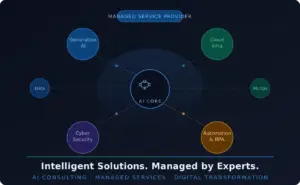
Charlotte has become a dynamic center for financial services and technology, and businesses here are eager to adopt artificial intelligence. For companies seeking AI Consulting Charlotte NC expertise, it’s important to have the right support. But without the right approach, AI can create more problems than it solves. Network Essentials brings together managed IT, cybersecurity, and AI consulting under one roof, giving Charlotte businesses a secure, governed path to AI adoption. We do not train on your data, and our enterprise-grade controls are designed for small and midsize companies. This is not generic AI consulting; it is a security-first partnership built on CISSP-certified expertise.
The AI Sprawl Problem: Shadow IT, Data Risk, and Zero Governance
Many organizations are already using AI tools without formal oversight. Employees sign up for free ChatGPT accounts, upload sensitive files, and connect third-party AI apps to company systems. This is AI sprawl; shadow IT that bypasses IT policy and creates serious data risk. In regulated industries like healthcare, finance, legal, and manufacturing, a single unauthorized AI use can lead to compliance violations.
– **Shadow IT:** Unapproved AI tools accessing company data without security review.
– **Data risk:** Sensitive information sent to public AI models that may use it for training.
– **Zero governance:** No policies for acceptable use, data classification, or vendor vetting.
The result is a patchwork of unmanaged tools that expose your business to breaches, regulatory fines, and reputational damage. Without a clear AI strategy, you lose control over your most valuable asset; your data.
The Solution: Secure, Governed AI Adoption
Network Essentials approaches AI the same way we approach IT infrastructure and cybersecurity; proactively and with governance built in. Our AI consulting services in Charlotte help you identify where AI can add value, then deploy solutions that meet your security and compliance requirements. We start with a thorough assessment and build a roadmap that includes policy, technology, and training. Our goal is to help you harness AI while keeping your data safe and your operations compliant.
AI Readiness Assessment
Before any AI project begins, we evaluate your current environment. Our readiness assessment looks at your data architecture, existing security controls, user workflows, and business objectives. We identify quick wins and high-impact opportunities, then map them against your risk tolerance. This assessment gives you a clear picture of where you stand and what steps are needed to adopt AI safely. We use a structured framework that covers people, process, and technology; because AI is not just a software purchase.
AI Policy Development
Every organization needs a clear AI use policy. Network Essentials helps you create governance documents that define acceptable use, data handling rules, vendor approval criteria, and employee training requirements. We align your AI policy with existing compliance frameworks such as HIPAA, GDPR, or SOC 2. This protects your business from liability and gives employees the guidance they need to use AI responsibly. A well-written policy also helps you avoid the free-tool chaos that leads to data leaks.
Microsoft Copilot Deployment
Microsoft Copilot is one of the most promising AI tools for business productivity, but it must be deployed with care. Our team handles license planning, security configuration, data source mapping, and user onboarding. We ensure Copilot respects your existing permissions so it only accesses data your users are already authorized to see. For regulated industries, we can restrict Copilot to specific Microsoft 365 tenants and apply data loss prevention policies. Deployment includes hands-on training so your team gets real value from day one.
M365 Tenant Assessment
Your Microsoft 365 environment is the foundation for many AI features. Network Essentials performs a deep tenant assessment that checks security settings, permissions, compliance controls, and data governance. We identify misconfigurations that could expose data to AI tools and recommend fixes before you activate any AI workload. This assessment is a prerequisite for safe Copilot deployment and for any AI solution that integrates with Microsoft 365. We also review your conditional access policies, audit logs, and retention settings to ensure full readiness.
AI Exploration and Ideation
Not every business problem needs a custom AI solution. Network Essentials runs structured exploration sessions with your leadership team to identify where AI can actually make a difference. We avoid hype and focus on practical applications that deliver measurable ROI. From automating document workflows to building intelligent chatbots for customer support, we help you test ideas in a sandboxed, secure environment. Our approach is iterative; we pilot small, learn fast, and scale only what works.
Why Network Essentials Is Different
Charlotte has several AI consulting firms, but most focus on technology alone. Network Essentials brings together three critical capabilities: managed IT services, cybersecurity, and AI consulting. Our team holds CISSP and other industry certifications, and we treat data security as the starting point for every AI project. We do not train public models on your data, and we use enterprise-grade controls even for small businesses. This is especially important for companies in healthcare, finance, legal, and manufacturing, where compliance is non-negotiable.
We are not here to sell you a big AI project. We are here to make sure that whatever AI you adopt is safe, governed, and aligned with your business goals. Our consulting services in Charlotte start with a free initial consultation to assess your needs and explain how we can help.
Get Started with AI Consulting in Charlotte
Ready to explore AI for your business? Contact Network Essentials today to schedule a free consultation. Our local Charlotte team will help you understand the opportunities and risks, and build a roadmap that fits your industry and budget. Whether you are just starting to evaluate AI or need to control an existing sprawl, we are here to guide you. Call us or fill out the form to begin your AI readiness journey.
Frequently Asked Questions
What is AI sprawl and why should my business care?
AI sprawl happens when employees use unauthorized AI tools that access company data without IT oversight. This creates security gaps, compliance risks, and lost visibility into how AI is being used. For businesses in regulated industries, AI sprawl can lead to data breaches and regulatory penalties that are costly to address.
How much does AI consulting typically cost in Charlotte?
AI consulting for small businesses can start around $1,000 per month, with custom enterprise packages available for larger or more complex needs. Many firms offer free initial consultations to assess your requirements before committing to a monthly plan. Network Essentials provides transparent pricing based on your specific scope and goals.
Do you train AI models on my company data?
No. Network Essentials does not train public AI models on your organization’s data. We enforce strict data governance controls, use isolated environments for any AI testing, and deploy tools that respect your existing security and permission settings. Your data remains yours and is never used to improve external AI systems.
Which industries benefit most from secure AI consulting?
Healthcare, finance, legal, and manufacturing organizations benefit significantly because they handle sensitive data and face strict compliance regulations. However, any business that wants to adopt AI safely can gain from a governance-first approach. Network Essentials tailors its services to the specific regulatory and operational needs of each industry.
Contact Network Essentials now to schedule your free consultation and take the first step toward secure AI adoption in Charlotte.